
A Practical Guide for Inventors
An intellectual property non-disclosure agreement is a contract that establishes confidentiality obligations when sensitive information is shared. For inventors, startups, and product developers, it can define how another party may access, use, and disclose technical or commercial information during a business relationship.
Developing an invention usually requires collaboration. Engineers need specifications, manufacturers need drawings, and potential partners may request technical details. A carefully prepared NDA helps establish boundaries for these discussions. However, its effectiveness depends on its wording, the applicable law, and how confidential information is managed in practice. Part IV: Trade secret management
What Does an Intellectual Property Non-Disclosure Agreement Cover?
An NDA focuses on confidential information associated with an invention, business, or development project. Depending on its terms, that information may include:
- Unpublished invention descriptions and technical drawings.
- CAD files, product specifications, and prototype designs.
- Source code, algorithms, and software architecture.
- Manufacturing methods, formulas, and testing results.
- Supplier details, pricing information, and commercial plans.
Not every confidential document automatically qualifies as a trade secret. WIPO explains that trade secret protection generally requires secrecy, commercial value arising from that secrecy, and reasonable measures to maintain confidentiality. An NDA can form part of those measures, alongside access controls and secure information handling. wipo.int
When Should Inventors Consider an NDA?
Confidentiality should be addressed before sharing sensitive details with an external party. Relevant situations include requesting a manufacturing quotation, discussing a technical collaboration, presenting an unpublished prototype, or exploring a licensing opportunity.
An initial conversation may require only a general explanation of the problem and the product’s intended benefits. Detailed drawings or explanations of the inventive mechanism can be reserved for a later stage, once confidentiality arrangements have been reviewed.
The European Patent Office recommends learning to communicate an invention’s business benefits without unnecessarily revealing its novel features. This approach can help inventors begin useful discussions while limiting early disclosure. epo.org
One-Way NDA or Mutual NDA?
The appropriate structure depends on who will disclose confidential information.
| Agreement type | Typical situation | Direction of confidentiality obligations |
|---|---|---|
| One-way NDA | An inventor shares technical information with a potential manufacturer | Primarily protects information disclosed by one party |
| Mutual NDA | Two businesses exchange confidential information while exploring a collaboration | Protects confidential information disclosed by either party |
A mutual agreement is useful when both sides contribute sensitive material. It should reflect the actual exchange rather than being selected automatically. The UK Intellectual Property Office distinguishes these structures according to whether information flows in one direction or both. GOV.UK
Key Clauses in an Intellectual Property Non-Disclosure Agreement
An NDA should reflect the project, the parties, and the information being exchanged. The following points provide a useful starting framework for discussion with a qualified lawyer.
Definition of Confidential Information
The agreement should clearly identify the protected information. Consider whether it covers written documents, digital files, physical samples, demonstrations, and oral explanations.
It should also explain any marking or written confirmation requirements. A process that protects labeled documents but overlooks technical discussions may leave uncertainty.
Permitted Purpose and Restrictions on Use
Confidentiality and permitted use deserve separate attention. The agreement should define why the recipient receives the information and what they may do with it.
For example, evaluating manufacturing feasibility is a narrower purpose than developing or commercially exploiting a product. WIPO highlights both the identification of confidential information and the definition of authorized use as central NDA considerations. Part IV: Trade secret management
Authorized Recipients
A company may need to involve employees, advisers, or subcontractors. The agreement should address who can receive the information and the confidentiality arrangements that apply to onward sharing.
This matters when the person attending a meeting is not the person who will perform the engineering or manufacturing work.
Exclusions and Required Disclosures
NDAs commonly exclude information that is already public without a breach or that the recipient can demonstrate was independently developed. Other exclusions and legally required disclosures also need appropriate treatment.
These provisions help define the agreement’s boundaries. Their wording should be assessed against the applicable law and circumstances. Part IV: Trade secret management
Duration and End-of-Project Handling
The agreement should distinguish the period during which information may be shared from the period during which confidentiality obligations continue.
It should also address what happens to files, samples, and copies when discussions or development work end. Confidentiality duties may continue after the wider contract ends if the agreement provides for that. GOV.UK
Does an NDA Replace a Patent?
No. An intellectual property non-disclosure agreement establishes contractual obligations concerning information. It does not grant a patent or establish that an invention meets patentability requirements.
Disclosure timing remains important. Under the European patent framework, information made available to the public before filing can form part of the prior art used to assess novelty. Confidentiality obligations may affect whether information was publicly available, but the facts of the disclosure matter.
Inventors should therefore coordinate disclosure decisions with professional patent advice. An NDA should never be treated as a universal guarantee that patent rights remain available after information has been shared. epo.org
Confidentiality and IP Ownership Are Different Issues
Keeping information confidential does not, by itself, resolve ownership of development results.
For example, a project may involve an inventor’s original concept, a contractor’s existing technology, and new drawings produced during collaboration. The parties need clarity about those different contributions.
A development agreement may need to address:
- Ownership of pre-existing intellectual property.
- Ownership of newly created designs, software, and technical results.
- Rights to use, modify, manufacture, or license project outputs.
- Access to editable files and other agreed deliverables.
These matters should be expressly reviewed rather than assumed from an NDA’s title. Government guidance on IP agreements distinguishes confidentiality from ownership and access rights for existing and newly created assets. GOV.UK
A Practical Disclosure Checklist
Before your next technical meeting, consider the following workflow:
- Define the meeting’s purpose. Decide what the recipient needs to evaluate.
- Prepare a limited information package. Separate a general overview from detailed technical materials.
- Arrange professional agreement review. Check the parties, scope, permitted use, and relevant jurisdiction.
- Confirm completion before sensitive disclosure. Keep the signed agreement accessible.
- Record what you share. Maintain dated versions of presentations, drawings, and meeting notes.
- Control later access. Review file permissions and document any additional recipients.
For example, an initial supplier conversation might focus on production capabilities and material options. Detailed geometry and tolerances can follow when they become necessary for a specific quotation.
This staged approach gives each disclosure a clear purpose.
Common Mistakes to Avoid
Common problems include sharing the complete technical package during an introductory call, assuming that every adviser is automatically bound by confidentiality, and using a generic template without reviewing its scope.
Another mistake is treating the signed document as the entire protection process. WIPO emphasizes that effective trade secret management also involves practical safeguards, including restricted access, document handling, and staff awareness. wipo.int
For overseas collaborations, obtain advice about governing law and enforcement arrangements before sensitive information crosses organizational or national boundaries.
Coordinating Confidentiality With Product Development
Confidentiality planning works best when it follows the technical stages of a project. Concept assessment, engineering design, prototype construction, and manufacturing preparation can each require different information packages.
Av Tipus supports product development through a technical team working in coordination with consulting patent attorneys. This connects technical development with coordinated patent-support activities according to the project’s needs.
You can arrange a confidential introductory meeting to discuss the technical stages relevant to your invention. For NDA drafting, interpretation, or other case-specific legal questions, seek independent advice from a qualified lawyer.
Frequently Asked Questions
Can an NDA protect an invention before a patent application is filed?
It can establish confidentiality and use restrictions before filing. However, it does not create patent rights or guarantee patentability. Disclosure and filing decisions should be reviewed with an appropriate patent professional. epo.org
Does an NDA prevent someone from independently developing a similar product?
An NDA does not automatically create exclusive rights over a technical concept. Trade secret protection generally does not prevent lawful independent development, and confidentiality agreements commonly address independently developed information through exclusions. wipo.int
Can oral discussions be covered by an NDA?
Yes, an agreement can cover information disclosed in meetings or presentations. Check whether its terms require identification as confidential or subsequent written confirmation, and keep a record of what was discussed. GOV.UK
Is a free NDA template suitable for every project?
No single template fits every disclosure. The parties, information, purpose, and governing law can differ. A template may provide a starting point, but professional review helps determine whether its terms suit the intended relationship. epo.org
Does signing an NDA transfer ownership of my invention?
Confidentiality obligations alone should not be treated as an ownership transfer. Review the entire agreement for any assignment, licensing, or development provisions, and address ownership expressly before collaborative work begins. GOV.UK
This article provides general information and does not constitute legal advice. Rules and enforceability vary by jurisdiction and circumstances. Av Tipus provides technical development and coordinated patent-support services, not legal services. For case-specific legal matters, consult an independent qualified lawyer.
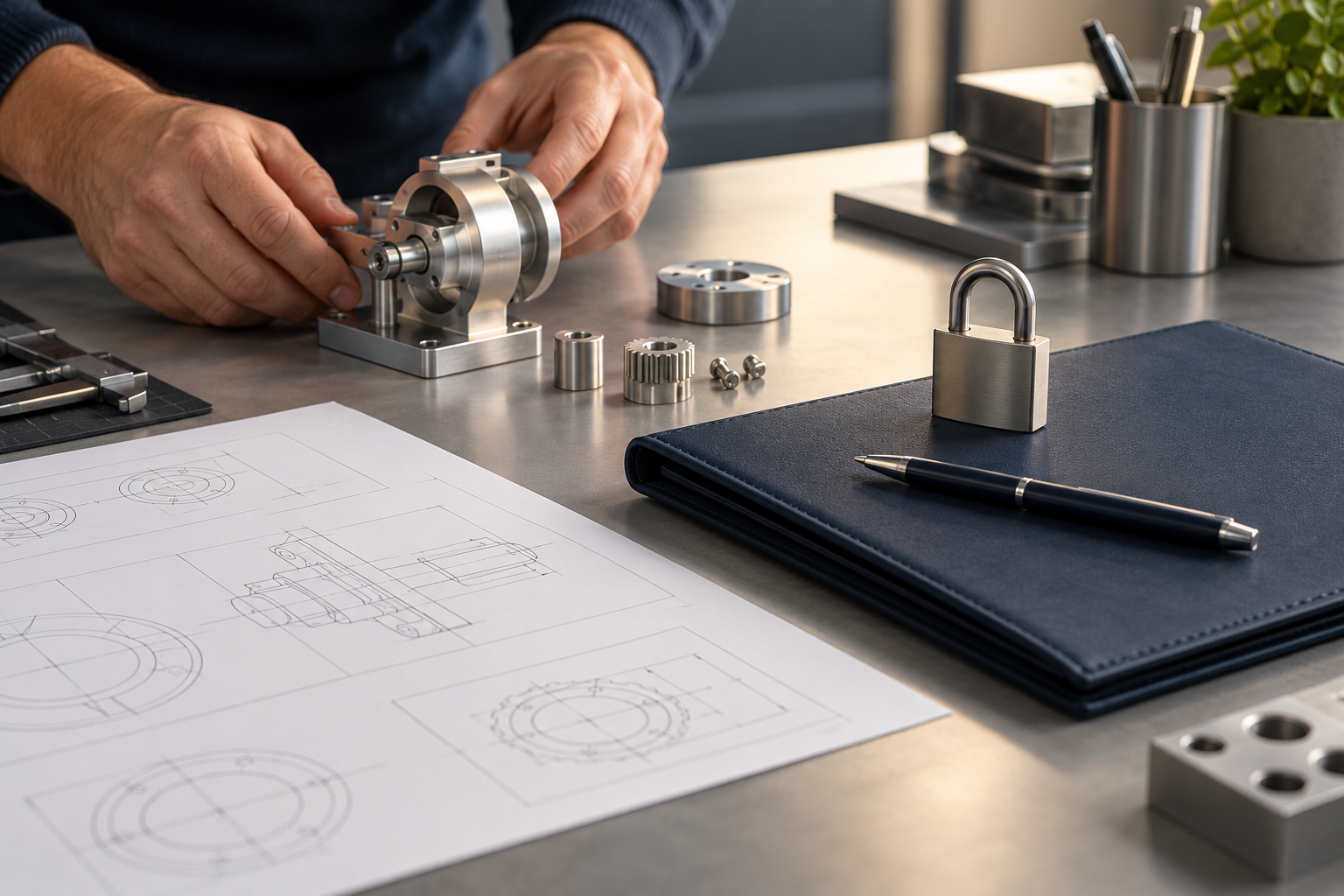
Image alt text: Mechanical prototype and technical drawings beside a locked document folder, illustrating intellectual property confidentiality.