
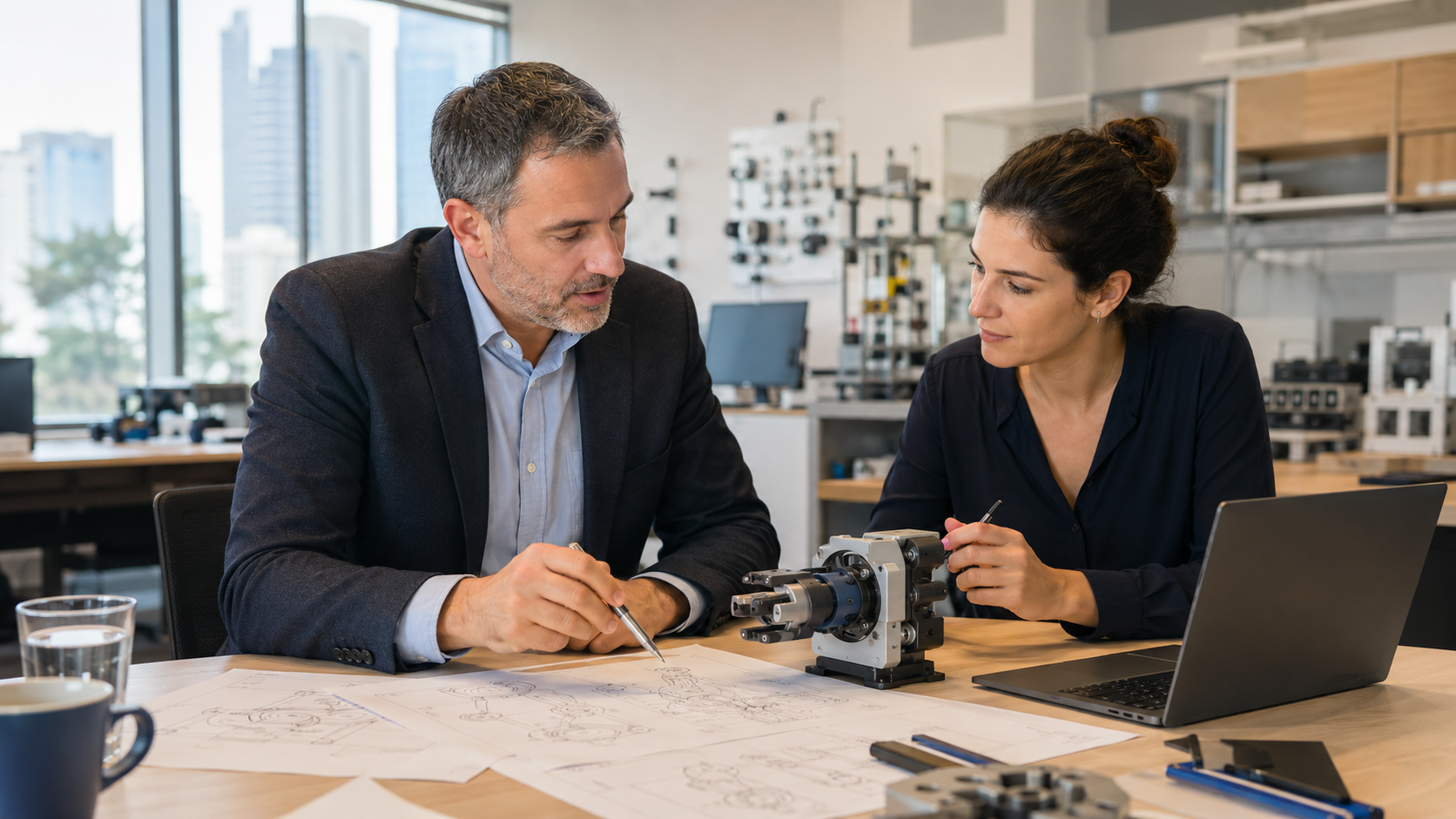
Turning an Invention Into a Clear Protection Strategy
A Patent Attorney helps inventors, entrepreneurs and companies evaluate inventions, prepare patent applications and navigate the patent process. However, effective patent protection begins before legal documents are filed. The invention must first be clearly defined from both a technical and commercial perspective.
An undeveloped idea may contain genuine potential, but it can be difficult to protect if its structure, operation and possible variations have not been thoroughly explored. For this reason, cooperation between a patent professional and an experienced product-development team can be highly valuable.
At Av Tipus Patents and Inventions Ltd., inventors can receive coordinated support that connects concept development, engineering planning, technical drawings, prototypes and commercialization preparation with the work of consulting patent attorneys.
What Does a Patent Attorney Do?
A Patent Attorney advises clients on protecting inventions through the patent system. The exact qualifications and permitted activities of patent professionals vary between jurisdictions. In Israel, licensed patent attorneys may represent applicants before the Israel Patent Office.
Typical responsibilities may include:
- Assessing whether an invention may meet relevant patentability requirements
- Reviewing prior art and patent-search findings
- Developing an appropriate filing strategy
- Drafting the patent specification and claims
- Preparing or supervising the filing of an application
- Responding to examination reports and objections
- Managing filing deadlines
- Coordinating applications in different countries
- Advising on patent ownership, licensing and related matters
- Supporting the enforcement or commercial use of patent rights
A patent application is more than a general description of an idea. It is a structured legal and technical document. Its claims define the protection being requested, which makes clear technical information essential.
When Should You Contact a Patent Attorney?
It is generally wise to obtain professional advice before publicly revealing an invention. Public disclosure may affect novelty and patent rights in many jurisdictions. The legal consequences can vary between countries, so inventors should not assume that a grace period will always protect them.
Consider consulting a Patent Attorney before:
- Presenting the invention at an exhibition
- Publishing information online
- Launching a crowdfunding campaign
- Approaching manufacturers without suitable safeguards
- Selling or demonstrating the product
- Sharing detailed information with investors
- Submitting an academic paper
- Offering the invention commercially
- Beginning an international filing process
Early guidance can help the inventor decide what information should remain confidential, what technical work should be completed and when an application should be filed.
A confidentiality agreement can reduce disclosure risks when speaking with service providers or potential partners. Nevertheless, an NDA is not a substitute for a patent strategy, and its effect depends on its terms and the relevant circumstances.
Can an Idea Be Patented?
A general idea, goal or commercial wish is not usually enough on its own. Patent protection generally relates to an invention that has been described in sufficient technical detail and meets the applicable legal requirements.
Depending on the jurisdiction, these requirements commonly include:
- Novelty
- An inventive step or non-obviousness
- Industrial applicability or utility
- Patent-eligible subject matter
- A sufficiently clear and complete disclosure
For example, saying “I want to create a device that saves water” describes a goal. It does not yet explain the technical mechanism that achieves it. The inventor may need to define the components, operating sequence, control method, alternative configurations and relationship between the parts.
This is where engineering development can strengthen the information available to the Patent Attorney.
Why Technical Development Matters Before Filing
Patent strategy and product development are different disciplines, but they influence each other. A patent professional examines the legal protection available for an invention. An engineering team explores how the invention can work in practice.
Technical development may reveal:
- Missing components
- Alternative mechanisms
- More efficient configurations
- Possible materials and manufacturing methods
- Control or software options
- Safety considerations
- Additional uses
- Design limitations
- Technical variations that competitors might adopt
These findings can help the inventor explain the invention more clearly. They may also provide the Patent Attorney with additional embodiments and alternatives to consider when preparing the application.
Filing too early, before the technical concept is sufficiently developed, can result in an application that does not fully reflect the invention’s potential. On the other hand, delaying a filing while publicly disclosing the invention can create serious risks. The timing should therefore be planned with qualified professional guidance.
What Information Should You Prepare?
The first consultation becomes more productive when the inventor arrives with organized information. The material does not need to be perfect, but it should explain the problem and the proposed solution.
Description of the Problem
Explain the practical problem that the invention is intended to solve. Describe who experiences the problem, how it is currently handled and why existing solutions may be inadequate.
Explanation of the Solution
Describe how the invention works rather than only what result it achieves. Identify its main components, stages or functions and explain how they interact.
Drawings and Visual Material
Bring any available sketches, diagrams, photographs, CAD files, animations or technical drawings. Even an early sketch can help professionals understand the concept and identify questions that require further development.
Known Products and Patents
List similar products, technologies or patents that you have already found. Do not hide information because it appears close to your idea. Relevant prior art can help a Patent Attorney evaluate the invention more accurately.
Development History
Document important dates, including when the idea was created, who contributed to it, whether contractors were involved and whether any information has already been disclosed.
Commercial Objectives
Clarify whether your goal is to manufacture the product, establish a startup, license the invention, sell the rights or approach strategic partners. The commercial plan can influence the patent and development strategy.
What Is a Patent Search?
A patent search examines published patent documents that may be relevant to an invention. It can help identify prior art, understand activity within a technical field and improve the inventor’s awareness of existing solutions.
However, a search does not guarantee that an application will be approved. Patent databases contain a large amount of complex material, and relevant documents may use terminology that differs from the inventor’s language.
A professional search may consider:
- Keywords and technical synonyms
- Inventor and applicant names
- Patent classifications
- Similar mechanisms
- Earlier publications
- Claim language
- Patent families
- Legal status information
The European Patent Office notes that patent databases include both applications and granted patents. Their claims can change during examination. Therefore, finding a publication does not automatically explain the final scope or legal status of the rights.
Patentability and Freedom to Operate Are Different
This distinction is essential. A patentability assessment asks whether an invention may qualify for patent protection. A freedom-to-operate analysis asks whether making, using or selling a product could fall within enforceable rights held by others.
An invention may be patentable because it includes a new improvement, yet its commercial implementation could still involve an earlier patent. Likewise, finding no identical invention during an initial search does not guarantee freedom to operate.
A Patent Attorney can explain which analysis is relevant and whether professionals in additional jurisdictions should be consulted.
Is a Prototype Required Before Filing?
A prototype is not always legally required for a patent application. Nevertheless, building a feasibility model or prototype may provide significant practical benefits.
A prototype can help:
- Test whether the concept works
- Identify engineering weaknesses
- Compare alternative solutions
- Improve technical explanations
- Demonstrate the invention to selected partners
- Estimate production complexity
- Prepare for investment discussions
- Reduce risk before manufacturing
The right sequence depends on the invention. Some projects benefit from filing before extensive prototype work, while others require initial testing to define the technical solution. The engineering team and Patent Attorney should coordinate the timing while preserving confidentiality.
Choosing the Right Patent Attorney
Choosing a professional should not be based only on price. Patent applications can influence the long-term value of an invention, startup or product line.
Consider the following factors:
- Experience in the relevant technical field
- Familiarity with the intended markets
- Ability to explain complex issues clearly
- Experience with international filing strategies
- A transparent scope of work
- Clear communication about fees and deadlines
- Willingness to coordinate with engineers and product developers
- A realistic approach without promises of guaranteed approval
- Understanding of the inventor’s commercial objectives
You should also ask who will perform each part of the work and which services are included in the proposal.
Patent Attorney, Patent Lawyer or Product Developer?
These roles are connected, but they are not interchangeable.
A Patent Attorney focuses on patent strategy, drafting, filing and proceedings before the relevant patent authorities, subject to local professional rules.
A lawyer may advise on contracts, ownership, licensing, disputes, company matters and litigation. Depending on the jurisdiction and the individual’s qualifications, a lawyer may also handle patent-related work.
A product developer or engineer focuses on the technical implementation of the invention. This may include concept planning, mechanical or electronic development, software, industrial design, technical drawings, prototypes and manufacturing preparation.
Many projects benefit from coordination between these professionals. The patent specialist needs accurate technical information, while the development team needs to understand which features and alternatives may be important to the protection strategy.
International Patent Applications and the PCT
Inventors often use the phrase “international patent,” but there is no single patent that automatically grants protection throughout the world.
The Patent Cooperation Treaty, commonly called the PCT, provides a system for filing an international patent application. It can simplify the initial filing process and postpone certain national decisions. However, each national or regional patent office ultimately decides whether protection will be granted within its jurisdiction.
The World Intellectual Property Organization recommends consulting a qualified patent attorney or patent agent when considering a PCT application. Deadlines, costs and local requirements must be checked for each case.
How Av Tipus Supports the Patent Process
Av Tipus provides an integrated framework for developing an idea into a technically defined, testable and commercially presentable invention.
Depending on the project, support may include:
- A confidential introductory meeting
- Signing a confidentiality agreement
- Initial review of the concept
- Definition of technical requirements
- Concept and product development
- Mechanical, electronic or software planning
- Two-dimensional and three-dimensional drawings
- Technical explanations for the patent process
- Coordination with consulting patent attorneys
- Feasibility models and functional prototypes
- Rapid prototyping and 3D printing
- Product-design and manufacturing preparation
- Investor presentations and commercialization materials
- Support in approaching manufacturers, investors or strategic partners
Clients can choose the complete process or only the stages they currently need. This flexibility is valuable for inventors who want to progress according to technical priorities, commercial objectives and available resources.
Common Mistakes Inventors Should Avoid
Disclosing the Invention Too Early
Publishing, marketing or demonstrating an invention before receiving professional advice may affect patent rights.
Filing Before Defining the Technical Concept
An incomplete description may fail to cover important variations or reflect how the invention will actually work.
Assuming a Google Search Is Sufficient
General web searches are useful, but they do not replace a structured search of patent literature and relevant technical sources.
Confusing Patentability With Market Potential
A patent does not guarantee demand, investment, manufacturing feasibility or commercial success.
Assuming a Patent Provides Permission to Sell
Patent rights are generally exclusionary rights. Receiving a patent does not automatically establish freedom to manufacture or market a product.
Ignoring Ownership Issues
Contributions from co-founders, employees, engineers and external contractors should be documented. Ownership questions are easier to manage before commercial value and disputes arise.
Frequently Asked Questions
Can a Patent Attorney Guarantee That My Patent Will Be Granted?
No responsible professional can guarantee approval. Patent examination depends on the applicable law, prior art, the application’s content and the conclusions of the relevant patent office.
Should I Build a Prototype Before Contacting a Patent Attorney?
Not necessarily. It is often better to seek advice early. A professional can help determine whether development, testing or filing should come first.
Can I File a Patent Application in More Than One Country?
Yes. Several filing routes may be available, including direct national applications, regional systems and the PCT process. The appropriate strategy depends on your markets, budget, invention and deadlines.
Does a Patent Search Guarantee That My Product Does Not Infringe?
No. A patentability search and a freedom-to-operate analysis serve different purposes. A search also cannot eliminate every possible legal or commercial risk.
How Much Does Working With a Patent Attorney Cost?
Costs vary according to the invention’s complexity, the required search and drafting work, the number of jurisdictions and the examination process. Ask for a written proposal that explains the scope, official fees and possible future stages.
Start With a Confidential, Structured Assessment
A successful invention journey requires more than filling out an application. The technical concept must be understood, the protection strategy must be planned and the next development steps must support the inventor’s commercial goals.
Av Tipus brings product development, engineering planning, prototype construction, manufacturing preparation and commercialization support into one coordinated process. The company also works with consulting patent attorneys when specialized patent services are required.
The first step is a confidential introductory meeting. It provides an opportunity to review the current status of the idea, identify missing information and decide whether the next stage should involve technical development, professional patent advice, a prototype or a combination of these services.
Schedule a confidential introductory consultation with Av Tipus and take the next practical step from idea to protected, testable product.
Authoritative Resources
- Israel Patent Office
- Israel Patent Office – Patent Attorneys
- WIPO – PCT Frequently Asked Questions
- European Patent Office – Novelty and Prior Art
This article provides general information and does not constitute legal advice. Patent requirements, professional titles and filing procedures vary by jurisdiction.